

I was going to go with another non-political animal post this morning, but Mister Mix’s post today on MAGA Trump pseudo-remorse sent me in another direction.
Mister Mix’s post ends with this paragraph:
“The key political point here is that Trumps cratering approval rating means that we’re getting down to the true believers, the Blaze readers and similar Trump supporters. These people don’t experience cognitive dissonance about Trump because they’re so used to believing nonsense that they’ll be “cooled out” by the media they consume. (I’d argue that their inability to feel cognitive dissonance begins with the explanations they’re fed about why a just and loving God would give babies eye cancer, but I digress.) These people are unreachable. There’s no political strategy that Democrats can employ to convince them. But the polls are showing that there are many who are reachable, so we need to concentrate on them. And, no matter what, we don’t need to be gullible enough to believe that people like MTG or Carlson could ever be allies.”
Then, I came up on this essay from Mike Brock, a former tech executive at Block (formerly Square).
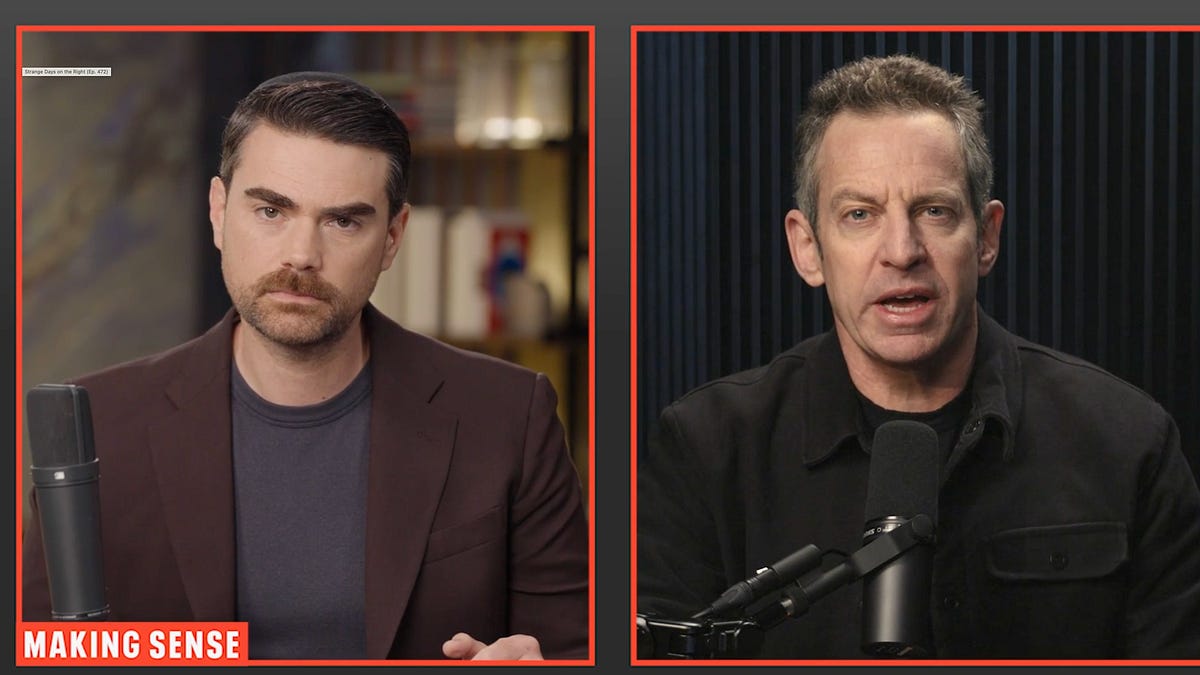
Brock wrote about an interview the execrable Ben Shapiro did with Sam Harris. Brock argues, and I agree, that there is another type of Trump supporter - the pseudo-intellectual apologist. IMHO, this column is incredibly important and mandatory reading for everyone because it lays out the tribal sham that is today’s Republican and “conservative” (in quotes because they are not in any historical way actually conservative but that’s how they label themselves and that’s how the utterly ineffectual stenographers known as the legacy media refers to them ) intellectual rationalizers.
I feel compelled to quote a fair amount of Brock’s column, because he hits the nail on the head perfectly (and way better than I could). He begins:
“Ben Shapiro went on Sam Harris’ podcast this week and gave the most clarifying interview I have read in a year. Not clarifying about Donald Trump, who has been clarified for some time. Clarifying about Ben Shapiro, and about the specific kind of figure that has been keeping the Republican coalition welded together while it converts itself into something its own apologists will not name…
Begin with what Shapiro concedes in this interview, because it is not nothing. It is, in fact, almost everything.
He concedes Trump’s family corruption “has surprised” him. He concedes the tariff catastrophe. He concedes the loyalists are unqualified. He concedes the reframing of January 6 is “corrosive of American culture.” He concedes Trump’s response to political murders is “truly terrible and I think morally egregious stuff.” He concedes Trump “called for the arrests of governors and mayors and even called for members of Congress to be hung for sedition.” He does not contest Sam’s characterization that Trump tried to overturn the 2020 election. He explicitly affirms it: “I think that it was quite risky what he did between the election and January 6th, as I made clear over and over and over.”
He concedes, in other words, the central claim of every liberal critic of the Trump project for the past decade: that the man at the center of it is a wannabe usurper who would have ended the constitutional order in 2020 if the institutional resistance had been weaker, who continues to test those institutions, and whose personal corruption has reached scales that would have ended the political career of any previous American president before lunch.”
Brock then goes on to eviscerate Shapiro (as he should and emphasis/bolding mine):
“And then, having conceded all of this, he explains why he voted for Trump anyway, why he would do it again, and why anyone who finds this position scandalous is engaged in hysteria.
The reasoning is the lunacy:
“The guardrails would largely hold... his worst mistakes would end up being mitigated by the pushback of reality.”
This is the argument. The president of the United States is a man who would, if he could, end the constitutional order. The reason it is acceptable to elect him is that he probably cannot. The institutions are strong enough to contain him. The Madisonian architecture will hold, the Supreme Court will strike things down, the Treasury Secretary lives on Earth, the bad picks will be replaced by the merely bad picks. The wannabe dictator is, in the Shapiro analysis, a manageable risk.
Sam pressed him. What if the guardrails do not hold. What if Trump nationalizes the elections, sends federal agents to seize ballots, declares emergency powers, refuses to leave. At what point does the risk to the constitutional order outweigh the policy gains.
Shapiro’s answer: “I also think that the guardrails are significantly stronger than people give them credit for.” And then, the move that names what he is:
“If you actually believe that electoral politics are worthwhile, then I do think that in the same way that I oppose what President Trump did between November of 2020 and January 6th in suggesting that the election was illegitimate and that he had won and that it was all voter fraud, I oppose that. In the same way, I oppose the sort of broad scale narrative that there is gigantic voter suppression happening because when you do that in evidence-free fashion, what you end up doing is undermining the very possibility of of acceptance of elections in general.”
The man who agrees Trump tried to steal the 2020 election is now arguing that the real threat to American democracy is people who worry Trump might try to steal the next one. The hysteria, in his framework, lies not with the man who attempted to overturn an American election but with the citizens who notice that he attempted it and might attempt it again. The proper civic posture, in Shapiro’s view, is to vote for the wannabe usurper, trust the guardrails, and treat the people warning about the usurper as the dangerous extremists corroding democratic legitimacy.”
In his post, Mister Mix talks writes about how “reformed” anti-Trumpers like Marjorie Taylor Greene and Tucker Carlson have abandoned Trump because “…the current Republican party — and especially the “thought leaders” therein — want power no matter what, and it’s clear that Trump is going to lead to them losing power.”
MM is totally correct on this perceptive analysis. However, Ben Shapiro unintentionally shows us the other side of abandoning a sinking ship: Trump supporters sticking with the ship no matter how certain they believe the ship will go down, because… they can always shift their goalposts (tortured mixed metaphor there 😬).
Brock further writes (again, emphasis/bolding mine):
“It is not even fair to call Ben Shapiro an ideologue. That would imply a coherent ideology being defended. What Shapiro is, is a partisan apologist of the most elite kind, whose job is to make the most plausible steelman case for voting his clan, in the language of the liberal intellectual tradition, in order to confuse people into going along with it.
The job is apologetics. Apologetics in the technical sense — the production of articulate defense for a position whose adoption preceded the argument and whose retention does not depend on the argument’s success. The position is the tribal commitment to vote Republican and defend the Republican coalition. The argument is whatever construction is required, in any given week, to make that commitment look like a considered judgment rather than a reflex. The arguments change. The commitment does not. The arguments change because reality changes — the Republican coalition produces new outrages, new figures, new contradictions, and the apologist’s task is to incorporate each new development into a defense of the unchanged commitment. This is what apologetics has always been. It is what the church fathers did. It is what the court philosophers of every regime have done. It is an honorable enough trade when the regime being defended is honorable. It becomes something else when the regime is what the Republican coalition has become.”
And then Brock lays out the apologists’ creed (once more, emphasis/bolding mine):
“The structure is one-way and worth naming plainly.
You concede every factual claim your interlocutor makes. Yes, Trump is corrupt. Yes, Trump tried to overturn the election. Yes, Trump’s loyalists are unfit. Yes, the reframing of January 6 is awful. Yes, the family enrichment is unprecedented. Yes, the response to political murders is morally egregious. You concede all of it.
You then argue that none of these concessions can justify changing your vote, because what you are voting for is policy. The policy is what matters. The character, the corruption, the constitutional vandalism — all of these are bundled with the policy and you cannot get the policy without the bundle. So you take the bundle. You take the wannabe dictator because you also get the tax cut, the conservative judges, the Israel alignment, the DEI rollback. The plumber fixes the toilet. The footprints on the floor are the cost of doing business.
When the interviewer asks what would constitute disqualifying behavior — the level of corruption, the level of constitutional violation, the level of cultural degradation — you respond that disqualifying is not a meaningful concept, because politics is binary and the alternative is worse. There is no level. There is no threshold. There is only the comparison. As long as Kamala Harris exists, Trump cannot be disqualified. As long as a Democrat exists who would do the wrong things on Israel or DEI or taxes, no Republican can be disqualified.
The implication, which Shapiro does not quite state but which is the only honest reading of his position, is this: there is no Republican who could be disqualified by character or conduct, because the alternative is always a Democrat, and the Democrat is always worse on policy. The category of disqualifying has been emptied. There is nothing a Republican president can do that would cause Ben Shapiro to vote against him, because the only available alternative would be a Democrat, and Shapiro has decided in advance that no Democrat can ever be acceptable.
This is not a political philosophy. This is a one-way ratchet. And the ratchet has a name. It is what authoritarian movements have always required from their apologist class, in every country where they have come to power: a class of articulate people who concede every factual point about the authoritarian, who acknowledge his crimes, who profess discomfort with his methods, and who continue to vote for him anyway because the alternative is the left. The apologists do not have to believe in the project. They only have to provide cover for the people who do, and to refuse, when asked directly, to ever pull the lever the other way.”
Brock is spot on. Shapiro’s “logic” stems from the Bizzarro World of Superman comics. It conflates anti-democracy actions like a constitutional crisis, an insurrection/attempted coup, breaking laws and ignoring judicial decisions with policy options like tax cuts, tariffs, immigration crackdowns and foreign wars of choice.
These two things - anti-democracy and policy - are not the same.
Shapiro simply just cannot abide Democrats in power, even though by any economic and national security measure, they perform better than Republicans when in power (links HERE and HERE).
Tribalism > policy > protection democracy > empirical outcomes.
Yeah - a few Trumpers are jumping ship. Great. But there are many more supposedly smart and thoughtful people on the right who will find any plausible reason - twisting logic - to continue supporting a mentally ill, pathologically lying madman. Even though they know the damage he is doing. Even though they admit he is unfit. Even though the economy is tanking. Even though we are stuck in a losing war.
There is so much more but this is getting too long. Read Brock’s entire essay.
