

“They say that patriotism is the last refuge
To which a scoundrel clings
Steal a little and they throw you in jail
Steal a lot and they make you king”
- Bob Dylan, “Sweetheart Like You”, 1983
There’s a reason Dylan is the first song writer to win the Nobel Prize for Poetry. But who knew he was a prognosticator as well?
Which brings me to the saga of Senator Ron Wyden, Jeffrey Epstein, Jamie Dimon, JP Morgan, other big banks, the United States Treasury Department and CBS’ 60 Minutes. It’s a sordid tale of elitism, power, dirty money, inequality and lack of accountability or consequences.
Senator Wyden published a report the other day called “Looking the Other Way: How Wall Street Banks Enabled Jeffrey Epstein’s Sex Trafficking.” It may be the defining story of late-stage capitalism and the inevitable decline of American society.
You can read the entire report HERE.

The details are disturbing, scandalous and descriptive of a “system” that has failed in reining in wealthy lawbreakers, corporations and the people that run them.
Key executives at Bank of America, Deutsche Bank, and JPMorgan Chase routinely ignored the suspicious activities of convicted child sex trafficker Jeffrey Epstein because he was among their most profitable clients, paying millions in fees and holding influence over other wealthy people, according to a new investigation released on Tuesday by Sen. Ron Wyden (D-OR).
The report looked at thousands of suspicious activity reports, or SARs. Those are confidential documents that banks and other financial institutions must file with the Financial Crimes Enforcement Network, or FinCEN, the U.S. Treasury’s financial intelligence division, when they identify unusual transactions. Executives have 30 days to file a SAR when they suspect things like money laundering or payments to terrorists.
According to Wyden’s report, Bank of America, Deutsche Bank, and JPMorgan Chase failed to do so for millions of dollars in cash withdrawals that had “no clear business purpose.” Instead, bankers let them ride, and together facilitated more than $1.4 billion worth of suspicious wire transfers over two decades—transactions they only flagged retroactively in 2019, after authorities arrested Epstein on federal sex trafficking charges.
The transactions they hid “included thousands of wire transfers, major withdrawals of cash, payments to women and girls, and correspondent banking in high-risk foreign jurisdictions (including Russia),” the report states. “They also include tens of millions in payments to his conspirator and convicted sex trafficker Ghislaine Maxwell.”
Investigative journalist Dean Blundell does a further deep dive into this scandal (and it IS a scandal of major proportions):
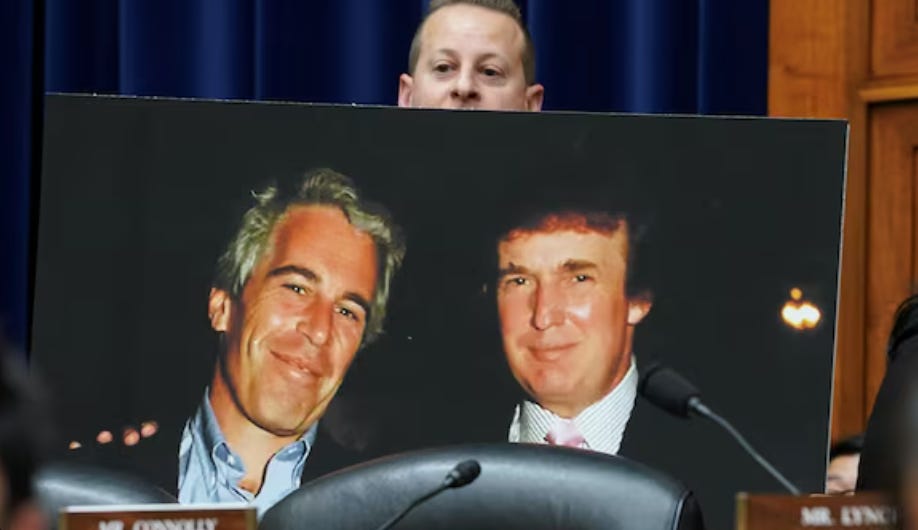
“JPMorgan Chase banked Epstein from 1998 to 2013. He and his associates held 134 separate accounts. More than $1 billion moved through them. The bank handled over $7 million in physical cash withdrawals — duffel-bag money, no explanation required — plus more than $3 million in direct payments to women, including wires to women in Russia, Belarus, and Turkmenistan. And more than $30 million to Ghislaine Maxwell, Epstein’s convicted co-conspirator, some of which bought her a helicopter.
When JPMorgan finally cut him loose in 2013, did it tell the Treasury Department what it had seen, like federal law requires? No. It waited until 2019 — after Epstein was arrested on federal trafficking charges and the delay became impossible to hide — and then dumped a filing flagging more than 5,000 wire transfers totaling $1.3 billion. That’s roughly 300 times what it had reported while he was alive and profitable.
Deutsche Bank picked Epstein up the moment JPMorgan dropped him, like a bar fight nobody wanted to break up. Same movie, second screening: after his arrest, the bank retroactively flagged more than $250 million in suspicious transfers. Wyden’s report describes Epstein’s own lawyer asking Deutsche Bank staff how much cash could be pulled without tripping an alert — and compliance wrote it down. Deutsche eventually paid New York regulators $150 million for its compliance failures. Federal enforcement? Zero.
Bank of America processed $170 million in wires from billionaire Leon Black to Epstein between 2012 and 2017, supposedly for “tax and estate planning advice” from a man who was not a licensed tax advisor. BofA didn’t flag any of it as suspicious until February 2020 — months after Epstein was dead — and later conceded the activity had no verifiable business purpose. Per Wyden’s investigators, Black supplied roughly 90 percent of Epstein’s income in that window, and in his settlement with the U.S. Virgin Islands, Black acknowledged that money helped fund Epstein’s operation there. (Black, for the record, has always maintained the payments were legitimate advisory fees, and his lawyer calls the report’s assertions outrageous and false. You can weigh that against the bank’s own admission about business purpose. Take your time.)”
…
Meanwhile, the compliance staff — the people whose job is literally “notice this stuff” — begged to cut Epstein off, and got overruled. Repeatedly. Per Dimon’s own sworn deposition, the final calls went up to the bank’s general counsel, who kept signing off.
Of course, when elite wrongdoing is involved, there is usually some sort of obstruction to ensure the public does not have access to the information needed to hold entities and people accountable.
“Wyden asked Treasury Secretary Scott Bessent for them three separate times in 2025. Denied, denied, denied. Then in January 2026, Treasury quietly confirmed it had already handed those same files to the Republican-controlled House Oversight Committee — while still stonewalling the Senate Finance Committee’s ranking Democrat. One party gets the records. The other gets a shrug.
Bessent’s public defence? That Treasury’s job is just to collect the reports. Which is hilarious, because his department fined TD Bank $1.3 billion and Capital One $390 million for exactly these kinds of anti-money-laundering failures. Treasury enforces this stuff constantly — apparently just not when the client list includes half the Forbes 400 and a former friend of the President.
When Wyden tried to force the records out with legislation — the Produce Epstein Treasury Records Act — Senate Finance Chairman Mike Crapo personally blocked it on the floor. And Senator Marsha Blackburn, who has built an entire brand on demanding “Epstein transparency,” spent two years dodging Wyden’s requests to co-sponsor a bipartisan subpoena while publicly complaining about being stonewalled by Democrats.”
_______________________________
Let’s take a quick look at the latest in a long string of business gurus (remember Jack Welch of GE, John Stonecipher of Boeing and Michael Milliken of Drexel Burnham Lambert, among others) and the most recent GOAT banker, Jamie Dimon.
In 2025, per the SEC, Dimon made over $40 million, roughly 363 times the median JP Morgan employee. While there is no definitive record of the ratio of CEO pay to median worker for big banks in 1976 (the rule mandating such reporting is called the Pay Ratio Disclosure Rule and is part of the Dodd-Frank Wall Street Reform and Consumer Protection Act signed into law by President Obama in 2010 which became effective in 2017), the Economic Policy Institute estimates that CEO to median worker pay was 27.7 times the median worker in 1976. That’s a ratio increase of over 1,300%.
Now, you might ask if CEOs are worth1,300% more than they were in 1976? Good question. Conventional reasoning would cite: greater use of stock awards in compensation with compensation increasingly tied to stock price rather than salary; deregulation and consolidation of the banking industry; much larger financial institutions after interstate banking and mergers; and competition among boards to attract and retain top executives (IMHO, the main factor is the small club of corporate executives and CEOs who sit on each other’s lucrative boards and take care of each other).
But I think there is a more relevant question. If CEOs are worth that much, shouldn’t they be accountable and responsible for what happens on their watch? Especially for failure to file legally mandated reports on suspicious activity like money laundering?
More directly, if CEOs are credited with the success of an entity via insane compensation packages, shouldn’t they also be responsible for failures of that entity, especially failures due to noncompliance with critical laws and regulations?
Side Note: It’s not unheard of.
As a reminder, during the Savings & Loan crisis of the 1980s, the U.S government had to resolve 474 failed banks with over $400 billion in assets. Importantly, individual bank executives were actually held responsible. 6,405 individuals were charged in major financial institution fraud cases. Prosecutors obtained 5,506 convictions, a 96.5% conviction rate. And 75.5% of those convicted, more than 3,700 senior executives and owners of failed savings and loans, received and served prison sentences. In addition, more than $45 million in criminal fines were imposed and courts ordered approximately $2.9 billion in restitution.
_______________________________
It’s worth reviewing and emphasizing the important points here:
Three major banks – JPMorgan, Deutsche Bank and Bank of America - broke the law by failing to report suspicious banking activity, and only reported it years after the fact when it no longer mattered;
Senior executives of all three banks were aware of the Epstein relationship;
Essentially no one in these financial institutions has been held responsible by the government or the institutions themselves - in any way - for this lawbreaking;
The Department of the Treasury is currently withholding key information from Congress and the public on these banks’ activities and reports (for which there seems to be no rationale other than to protect wealthy elites);
_______________________________
Jamie Dimon is a CEO who makes over $40 million per year, and whose net worth is estimated at $3.2 billion. Dimon accrued that wealth primarily through his career in helping run financial institutions such as American Express, Citigroup and JP Morgan.
Jamie Dimon became ultrawealthy because he was credited with the financial success of those organizations.
In this instance, Dimon and his peers are doing what late-stage capitalism does best: privatizing success (profits) and socializing failure (losses and law-breaking).
Jamie Dimon is also nominally a Democrat. I don’t give a flying f^*k. As the highly compensated leader of JP Morgan, Jamie Dimon needs to be held accountable for the serial lawbreaking of JP Morgan regarding flouting laws requiring reporting of suspicious account activity, specifically regarding the leader of the world’s worst sex trafficking ring, Jeffrey Epstein.
The same goes for executives and CEOs at the other financial institutions that actively underwrote Epstein’s depraved and illegal actions.
And it should also go without saying that people like Secretary of the Treasury Scott Bessent should be held personally responsible for obstructing justice and withholding public information about criminal activity (there’s a whole ‘nother issue of public “servants” working for the public in government agencies keeping public information secret for the benefit of “insiders” and an elite view).
_______________________________
This is a no-brainer issue for Democrats. It combines the Epstein Class, elite institutional corruption, money laundering, media capture by oligarchs, and lack of accountability/consequences in an easily understandable narrative that - again - can be tied to pocketbook issues that directly impact “regular people”.
Bob Dylan - Sweetheart Like You
