Personally, I’m not a fan of peanut butter in my chocolate sweets, which means - horror of horrors - I am not a Reese’s Peanut Butter Cup fan. Not an enemy; just not a fan.

However, I did come across this article and found it both interesting and scary at the same time.
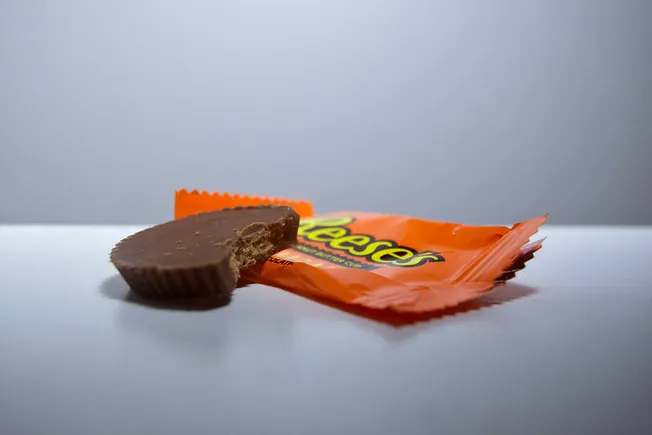
“Last month, Brad Reese — grandson of the man who invented the peanut butter cup — bit into a Reese’s Valentine’s Day heart and posted an open letter to Hershey. The chocolate coating, he said, wasn’t chocolate anymore. It tasted cheap. It tasted wrong.

Within days, the story was everywhere. Not because a candy heir was upset, but because millions of people recognized the feeling. That quiet moment when something you’ve eaten your whole life tastes different, and no one told you why.

Hershey had swapped milk chocolate for a compound coating on several seasonal products — a move almost certainly driven by cocoa prices that have surged by 400% in the past decade, as climate-driven droughts devastated harvests across West Africa, where the majority of the world’s supply is grown. The company said the classic Reese’s cup itself hasn’t changed. That may be true. But the fury wasn’t really about one product. It was about the feeling of being quietly deceived by something familiar.

This keeps happening. And it’s never about what we think it’s about.

…

We are living through a period in which climate change is arriving not as a dramatic event most people can point to, but as a slow degradation of things they love. A chocolate that tastes a little off. A wine that lost its crispness. A coffee that’s not quite what it was. The changes are small enough to notice but hard to explain, and in the absence of an explanation, we reach for the most available story: the company got greedy.

That story is almost always wrong — or at best, incomplete. The more accurate version is harder to sit with. The ingredient your grandmother used, the flavor you grew up on, the product that felt like it would never change — it is changing because the agricultural systems that produced it are under stress that is not going away.

…

This is, in a sense, an anthropological phenomenon. Climate change has been discussed for decades as a matter of science, policy, and politics. But for most people, it doesn’t arrive as a carbon parts-per-million number or an IPCC report. It arrives as a broken promise from a brand. A taste that shifted. A price that jumped. A package that got smaller. We process planetary disruption through the most intimate lens available to us: the things we eat.

And so the outrage is real, but misdirected. We are, collectively, grieving changes we don’t fully understand by blaming the nearest visible actor. The company becomes a proxy for a system-level failure no single company created.

When a key ingredient becomes unreliable, any company in the food industry faces the same brutal trilemma: raise prices and lose customers, shrink portions and hope no one notices, or substitute quietly and pray the taste holds up. These aren’t good options, but they’re the only ones available within a system built on the assumption that agricultural inputs would remain stable and cheap.

Well, that assumption is breaking. Cocoa is the headline today, but the same dynamics are playing out across fats and oils — ingredients responsible for roughly 7% of global greenhouse gas emissions, on par with every car on the road. Butter prices have more than doubled in the past decade, along with coconut oil and palm oil. Not to mention how palm oil carries well-documented environmental and human rights risks that make sourcing increasingly complex.

The ingredients that give food its richness, texture, and indulgence are simultaneously becoming more expensive, less predictable, and more ethically fraught to produce.

The food industry has spent generations getting extraordinarily good at optimizing within a system it inherited. What it hasn’t done — what no individual company can do alone — is build alternatives to the system itself. That work is beginning, but none of us are at the scale the world needs yet.

The question the Reese’s backlash really asks isn’t “why did Hershey change the recipe?” It’s whether the food system can move fast enough to give companies better choices before the next ingredient fails — and the next, and the one after that.

The peanut butter egg is a small thing. What it represents isn’t. And until we start seeing these moments for what they are — not corporate betrayals, but climate symptoms — we’ll keep having the wrong argument while the real problem grows.”

Maybe this impact - losing out on the taste of Grandma’s chocolate chip cookies or anything cooked with real butter - will be the catalyst that wakes people in our country up to the impacts of climate change. Personally, I’m not sure how I’ll survive climate change if my chocolate addiction can’t find real chocolate anymore 😬

Reply

Avatar

or to participate

Avatar

TBone Dinosaur8 months ago

If you think it's a bad situation with chocolate (and it is), just wait till our coffee is adulterated with chicory, etc

https://www.npr.org/2025/09/30/nx-s1-5553625/coffee-day-farmers-industry-climate-change-labor-stenophylla

Avatar

TBone Dinosaur8 months ago

"Coffee producers have no immediate plans to move away from arabica, coffee experts said. But researchers are already planning for what comes next as temperatures increase.

The coffee world has been buzzing about recent research into a lesser-known coffee species called stenophylla. It's been found in Sierra Leone and can tolerate hotter temperatures than arabica. And notably, it has a similar taste."

"Similar" like carob?

Avatar

r po8 months ago

Yeah, I'm not feeling this explanation. If anybody here understands what happened to the original Stoned Wheat Thins crackers (SWTC) about 10 years ago, I'm thinking that management strategy at "Reeses" is a lot more likely to do with what happened here with peanut butter cups (RPBC).

If you search hard on the situation with SWTC, you will not find out that simultaneously, without any mention on the packaging, the flavors tilted straight toward bargain saltines and the texture became overly brittle, so that the dividing part down the center no longer cracked cleanly, and they fell apart in your hands when you wanted to make some crackers and cheese. There were hundreds of angry customers on Amazon comments all bitching about this. We've been eating them for 40 years and there was no disputing it. The stories you do find on the web are completely speculative and don't mention any of this. I'm thinking it's a successful wipe.

Now with RPBC the complaint in this story is

Avatar

mister mixAuthor8 months ago

I hadn't had SWT for a long time and bought some recently and wondered if they were always this bad. Thanks for the explanation.

As for Reese's and the other mfrs using fake chocolate, my take is that Trader Joe's still manages to sell chocolate peanut butter cups that use real chocolate, so it's just bean counters enshittifying the big name chocolate candy.

Avatar

Joe is Wypoxic8 months ago

Can’t go wrong with Trader Joe’s. See my comment to r po above…

Avatar

r po8 months ago

Trader Joe's aren't bad, but the gold standard was SWTC. They were a thing. A basic culinary ingredient.

I have spent an embarrassingly huge amount of time searching for a replacement, and thrown out many nearly full packages. It's something I've got as a task in the back of my mind the next time we get to Europe. I need to search out a mega Carrefour grocery and see what they got.

Avatar

Scott H8 months ago

Thank you for this. I didn't know the back story but like tons of people, tasted the change immediately.

Avatar

r po8 months ago

Oops I thought you were talking crackers, not chips. Wife vetos TJs chocolate, but I'm kind of a slummer on chocolate. It's the wife and daughter who are the chocolate snobs. Although I do admit that the chili cacao bars at Xhuladii Chocolates in Oaxaca cracked right through my banal chocolate preferences. Outstanding!

Avatar

r po8 months ago

that due to climate change the price of chocolate has gotten to expensive. I just asked the house baker, who has for 40 years been buying premium chocolate online for baking her exquisite stuff, whether or not chocolate had meaningfully increased in price over the last ten years and she says definitely not. Now some stuff has definitely had large price increases due to climate change. Penzeys Spices will tell you all about premium vanilla price hikes from Madagascar.

We've also been to divine chocolatiers in Ensenada and Oaxaca MX in the last five years, multiple times, and spent a lot of time talking to the friendly proprieters. No mention of it.

Avatar

Joe is Wypoxic8 months ago

I wouldn’t doubt it and, frankly, don’t know enough. The article did peak my interest though. More research to come.

I will say that my “go to” small snack is a few Ghirardelli 60% chocolate chips. Their price has increased 100-200% over the past year or two. I’ll never let corporate profiteers off the hook, but even that price increase seems too much to just be about larger margins.

Avatar

r po8 months ago

I do the same thing! Maybe 5- 20 chips max. Ghirardelli price hikes I believe are true, I have bought them a few times when they're 2 for 1 but mostly get the Nestles dark for snacks. A couple of months ago I bought a big bag because it was considerably cheaper/oz. Small bags were double/oz. But my wife's current goto for premium bulk baking is Bensdorp.

Anyway, the problem with RPBC is it could be both! Ingredient price increase is a convenient excuse for management to commit to the bit on enshittification. We actually came to that conclusion that's what happened with the SWTC enshittification years ago. Something got more expensive and so... make it cheaper, any way possible.

Avatar

Joe is Wypoxic8 months ago

I never realized SWTC was such a thing! I’ve always liked them, but for some reason, never as a stand out. I think going to Europe and Carrefours or other markets is a great idea. Let me know what you find out.