

Today’s column may be a bit freewheeling and stream of consciousness, but I hope the point(s) gets across in the end.
I was struck by three seemingly unrelated articles yesterday that, in my view, were actually completely intertwined.
First, The WSJ wrote an article on Secretary of the Treasury Scott Bessent. I’m not sure of the intent, but in my view, even though there were people who came to Bessent’s defense, it was not very flattering for a host of reasons.
Inside Bessent’s Treasury: Tension, Turnover and Unmet Economic Goals
Ahead of midterms that could turn on high prices and borrowing costs, secretary dresses down officials
Third, also in the WSJ, this:
The S&P 500 Hits a New Record High, Powered by Tech—and Not Much Else
Most U.S. stocks are down, but the market’s AI engine is firing on all cylinders
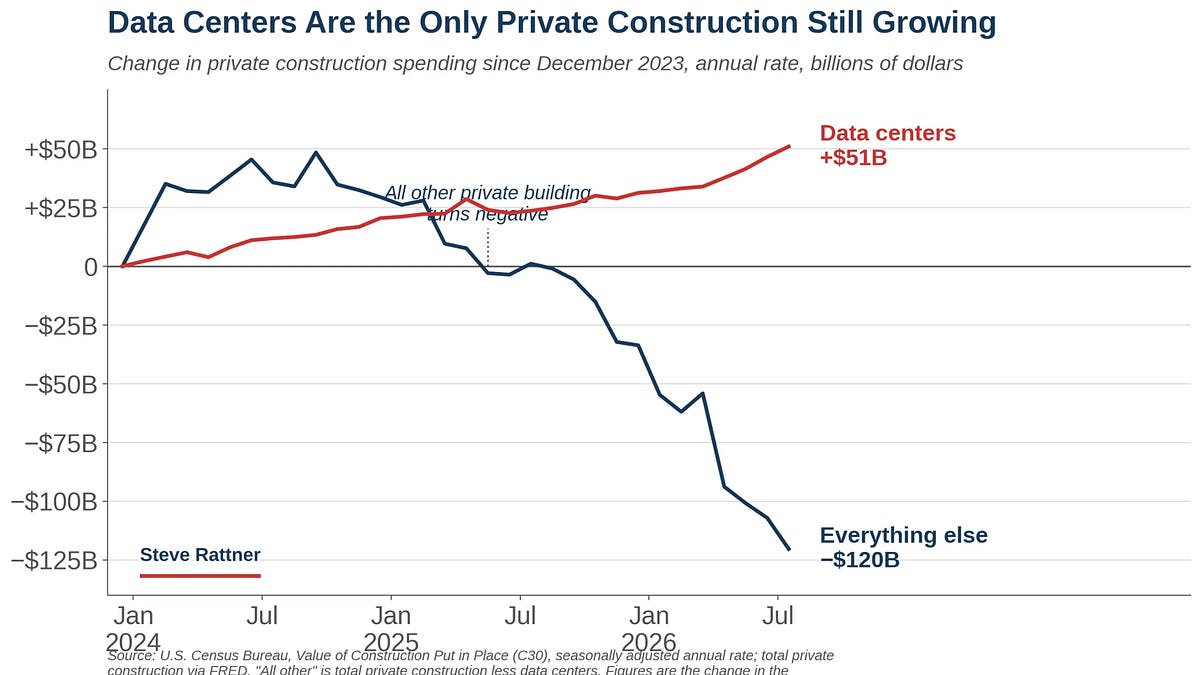
Let’s start with Krugman and that graph (enlarged below):

Krugman’s argument - and that graph - show pretty clearly that AI is crowding out private and government investment in other sectors of the economy (manufacturing, construction, etc.):
“We don’t have to guess, however, about one major effect of the AI boom, because it’s happening right now: Massive spending on data centers is crowding out investment in everything else in the economy.
“Crowding out” is a familiar term in economics, usually considered a consequence of government spending. When a government engages in deficit spending and the economy is at or near full employment, it drives up interest rates. That’s because, at near or full employment, the private sector is using all the available credit in the economy at the current interest rate. Therefore, in order to attract enough funds to satisfy its deficit, the government has to offer a higher interest rate. And this, in turn, leads to lower private investment. In effect, private investment is “crowded out” by the government deficit.”
Krugman’s observation/analysis is seemingly bolstered by the bifurcated performance of the equity markets as stated in the WSJ article (bold emphasis mine):
“The AI trade is propelling stocks to new heights—and it is dragging the rest of the market along for the ride.
The S&P 500 and Nasdaq composite blew past new closing records on Tuesday, the latest leg of a rally that has powered through everything in its path, from the Federal Reserve’s decision to raise rates for the first time in three years to a monthslong war that lifted oil prices to $100 a barrel.
Increasingly, the market is running on one engine: a familiar cast of tech companies that are building out (and benefiting from) the AI revolution. Nvidia, whose grip as the dominant supplier of chips that power AI has made it the world’s most-valuable company, has jumped 4.5% in the past week to a new all-time high. Meta Platforms is up 24% since Aug. 13, when the S&P 500 had its previous high.
Just about everything else is going down. Shares of healthcare firms, banks and consumer staple companies are declining. So are small-cap stocks. And blue chips, like the Dow industrials.”
So…
We’ve got an economy that is basically totally tied to - and currently dependent on - one sector that is, in all likelihood, in significant bubble territory.
Essentially, it seems we need to give all of our investment capital to the billionaire AI tech bros or our house of cards will collapse. Great.
I want to pause the AI thoughts here and interject another point Krugman makes - something I have been saying for years (as always, bold emphasis mine):
“A second question is, shouldn’t we assume that the private sector knows what it is doing -- that the reallocation of investment toward AI and away from everything else makes economic sense?
Definitely not. We shouldn’t assume that this reallocation of investment makes economic sense for the country as a whole. Through the tax code, and especially through changes in the tax code in Trump’s One Big Beautiful Bill, the data center boom is effectively being subsidized by taxpayer dollars.
Moreover, we shouldn’t assume that the private sector knows what it’s doing. There’s often a double standard when thinking about bad investments, in which public investments that go bad are treated as evidence that the government can’t do anything right, while private malinvestment is brushed off as no big deal.
Think about the $80 billion that Meta, formerly known as Facebook, spent on the “metaverse,” only to basically abandon the concept. A government program that spent $80 billion on a failed project would be the subject of endless Congressional hearings. Yet the waste from a failed private investment is equally real.”
Ever since Reagan, when our blind worship of the free market kicked into high gear, we’ve been led to believe that the free market would solve all of our problems - always making rational decisions - while government couldn’t do anything right. Again, one of Reagan’s most damaging utterances (and there were a lot) was, “The nine most terrifying words in the English language are: I'm from the Government, and I'm here to help.”
I’ve argued for years that the green dollars paid to government workers and that circulate thought our economy are no different from the green dollars paid to private sector workers. And government’s role is NOT to act like a private business. Businesses goals are to take risk in order to continually grow and make more and more profit. Government’s goal is to promote “Life, Liberty, and the pursuit of Happiness” by undertaking “…to form a more perfect Union, establish Justice, insure domestic Tranquility, provide for the common defence, promote the general Welfare, and secure the Blessings of Liberty to ourselves and our Posterity.”
Simply working in the private sector does NOT make anyone more intelligent or more rational than someone working in the public sector. This is clearly evident in the irrational private sector economic bubbles that periodically endanger our economy and create economic misery when they burst.
Which brings me to Scott Bessent, he who is tied with Kevin Hassett for having the most punchable face in the Administration.
The WSJ article paints a picture of a mercurial boss with a megalomaniac complex and an unbridled temper. Warning - lengthy excerpt (you guessed it - bold emphasis mine):
“Bessent’s behavior was a factor—and sometimes the most-important one—in the departure of multiple key officials, people familiar with the matter said.
Since he became Treasury secretary in early 2025, Bessent has dressed down senior advisers and junior staffers alike over issues large and small, according to more than a dozen current and former Treasury officials.
…
His backers say his hard-charging style gets results. But 20 months into his tenure at the department, Bessent is facing skepticism on Wall Street and an economy that could wreck Republican chances in November’s midterm elections.
…
Bessent, meanwhile, has projected unwavering confidence. He has dismissed his critics as “Bloomberg terminal bros,” referring to those on Wall Street questioning his moves, and quipped in a recent interview, “I am the house now,” citing the insights he has gained as Treasury secretary. “You can bet against me if you want.”
He has become increasingly emboldened, making unilateral decisions that have confounded even some of his longtime allies and friends.
And his temper has flared. He has shouted at staff for not moving fast enough to implement his ideas and for failing to combat unfavorable media coverage, some of the officials said. Last year, Bessent got so angry about the way his daily briefing book was organized that he picked up the binder full of papers and threw it at a wall, people familiar with the matter said.
Bessent denied the account to The Wall Street Journal.
“A lot of people in the investment community had hoped he was the adult in the room,” said Stephen Myrow, a former Treasury official and managing partner at Beacon Policy Advisors. Investors are “starting to see him as acting more and more like Trump…and that’s shaking confidence in him.”
…
The episode is emblematic of how Bessent runs the department, according to people familiar with his methods. Bessent has consolidated power in his massive agency, often relying on a handful of advisers to carry out the president’s agenda.
…
Some who cross the secretary or the White House have been sidelined or pushed out of the department.
As of the end of August, seven Senate-confirmed officials had left the department, according to the Partnership for Public Service, a nonprofit group, compared with zero to two in the past four administrations during similar time periods, including Trump’s first term.
Only one of the recent vacancies under Bessent’s watch has been filled with another Senate-confirmed official. Dozens more non-Senate confirmed officials have left the department since Bessent was sworn in.
The department currently doesn’t have a Senate-confirmed general counsel or head of legislative affairs, nor does it have Senate-confirmed officials overseeing tax policy or domestic finance, although two of the positions have nominees.
Bessent, who oversees the Internal Revenue Service, has also presided over historic turnover at that agency. Since Trump took office, the IRS has cycled through five acting IRS commissioners, and the position is currently vacant. Bessent created a new, non-Senate confirmed role overseeing the agency, appointing ally and Social Security Administration chief Frank Bisignano as the IRS’s CEO.
Bessent’s reputation as a challenging boss has complicated efforts to fill key vacancies at the department, according to people familiar with the matter. Several potential recruits said they decided not to pursue job opportunities at Treasury because they had heard about Bessent’s behavior.
…
At Treasury, current and former department officials described in interviews a high-stress work environment that veterans of past administrations said was more intense than they have experienced.
People who have worked with Bessent said he often appears calm but can excoriate staff when he is frustrated. Some aides said they ask colleagues about the secretary’s mood before coming into contact with him, and trade advice on how to avoid him when he is angry. Several officials described feeling relieved when Bessent was away from the office.
The Treasury secretary cycled through three people filling the role of chief of staff before settling on Kate Tyrrell in June. Dan Katz, Bessent’s first chief of staff, was among the officials who clashed with Bessent, according to people familiar with the matter. He left the agency in fall 2025 to be a senior official at the International Monetary Fund.
Bessent sometimes lashed out at Katz in meetings when he offered counsel on policy matters, according to some of the people.
…
Bessent and his allies have worked to protect his public image, battling reporters in public and private over their coverage. The Treasury secretary yells at his communications staff over stories or headlines he doesn’t like, current and former officials said.
After the Journal wrote a story about Bessent’s purchase of government bonds that Bessent objected to, the Treasury Department blocked a Journal reporter from attending a press conference where the secretary announced his plan to isolate Iran through stepped-up economic sanctions.
The department also revoked the credentials of reporters from the Journal, the New York Times and Bloomberg to cover a G-20 finance ministers summit in North Carolina. Bessent has complained about all three news outlets’ coverage of him. He has also taken issue with the Financial Times over its coverage. In a recent Axios interview, Bessent called the FT a “disgraced publication” and accused them of being “anti-American.”
When hecklers from the liberal group Code Pink interrupted the Treasury secretary at a Washington restaurant in December and criticized the Trump administration’s economic sanctions policies, Bessent called them ignorant and erupted at the owner of the restaurant for not removing them. According to the owner and also a nearby diner, Bessent spit in his own food before leaving.
“When people legitimately question what he’s doing he falls back on ad hominem attacks,” said Myrow, the managing partner at Beacon Policy Advisors. “
So…
We’ve got a Treasury Secretary who berates his staff, presides over debilitating organizational turnover, seems overly concerned with his reputation, and drives away good people.
Not a shining example of leadership and management. And no wonder things aren’t going his way.
But there’s a bigger issue here that Krugman gets but the Journal - and much of the rest of the media - glosses over. It’s easy to miss, but Bessent is hamstrung, and IMHO, destined to fail, because, truly, his sole job is to “carry out the President’s agenda”. This is also why Rubio and Hegseth and other Admin sycophants are destined to fail as well (along with the fact that most of them are woefully unqualified and incompetent in their own right). Bessent was supposed to be different, but it turns out it doesn’t really matter how successful you’ve been in the past when your only remit is to follow an idiot and try to make him look good.
Simply put, the President has no coherent agenda. As I’ve previously written, Trump will do and/or say anything today - even if it totally contradicts what he did/said yesterday - in order to 1) enrich himself, 2) stay at the center of attention, and 3) stay one step ahead of the carnage he has previously created. This means his “agenda” is based on the greedy, uneducated, ignorant whims of a mentally ill madman.
So Bessent has to try to prop up Argentina just because Trump likes Milei. Bessent has to figure out how to reverse damage from Trump’s inflation-producing, economic growth reducing, job cut inducing tariffs. Bessent has to figure out how to make sanctions work against Iran because Trump thought he could do to Iran what he did to Venezuela and now can’t figure out how to extract us from his war-on-a-whim. Bessent has to work at bringing interest rates down just because Trump wants them down while the Fed works at odds to Bessent to bring rates up due to inflationary pressures from the aforementioned tariffs and the aforementioned stupid war.
I’ll let David Roth of Defector finish up. While he is writing about the fool that Missouri Senator Eric Schmitt made of himself trying to entrap Jack Smith, Roth’s words apply so well to Bessent and the rest of the gang that couldn’t govern straight:
“It is true that none of it exactly adds up to anything, but also that is not really how senators like Schmitt understand their job at this moment. The patient [Trump] is very sick, very vain, and almost unbelievably stupid; his heirs and viziers are loose and at prey throughout the world, trying to do and take and damage as much as they can before any of the institutions notionally charged with stopping this sort of thing bestir themselves to interrupt or even mildly inconvenience that predation. Schmitt belongs to one such institution, but he is doing a very different job. He is there, like the rest of his cohort, to tell that patient a story about himself, one in which he is both always in danger and always and inevitably victorious. The story doesn't have to make sense, really; there is only one character in it who will ever matter, and Schmitt knows as much. He knows that his job is to keep the patient comfortable.”
It’s a fool’s errand. And it’s doomed to fail.
I guess Bessent didn’t listen to the formerly worst President in history - George W. Bush - who so eloquently said, “Fool me once, shame on you. Fool me - you can’t get fooled again.”
The Who - Won’t Get Fooled Again
