

I’ve written before about the “Trump Creed” - that Trump will do or say anything on any given day - even if it conflicts with what he has done/said previously - for two primary reasons: 1) to sate his malignant narcissist need to be venerated front and center, and 2) to stay one step ahead of the carnage he has left in his wake.
Which brings us to his latest desperate gambit:

President Donald Trump on Friday morning said the United States will allow up to 300,000 metric tons of product for ground beef to be imported over the next three months without being subject to out-of-quota tariffs.
Trump also said, “We have a commitment that this beef will be sold at 25 percent below current market prices.”
Trump is trying to buy-off consumers by dumping foreign, below-market beef into the U.S. because retail beef prices have soared due for a variety of reasons, including meatpacker concentration and the lowest herd count since the 1950s.
There are so many things wrong with this is hard to know where to start. I’ll list just a few:
Obvious Election-Related Move. Conveniently, this one-time exception to tariffs and quotas will last for 3 months, until just after the November midterm elections. A typical Trump move to “skate-as-fast-as-you-can” to try and avoid consequences from his malignant narcissistic incompetence.
Government Price Controls. Additionally, the guy who accuses every opponent of being a “communist” and of deriding government actions while worshipping the “free market” is now instituting - if only temporarily - price controls over imported beef.
Harming His Core Base. Perhaps the most unbelievable aspect of this desperation move is that Trump is doing direct economic damage to a key component of his core MAGA base: rural ranchers. Dumping below-market beef into the U.S. will further depress prices that ranchers get from meatpackers for their beef cattle.
None of this is surprising if we run this action through the Trump Creed mentioned above. He will throw anyone under the bus in order to make it all about him and stay one step ahead of the law.
However, in this instance, he’s truly pissed off an unlikely constituency: rural state Republican senators who fear for their own political careers and well-being.
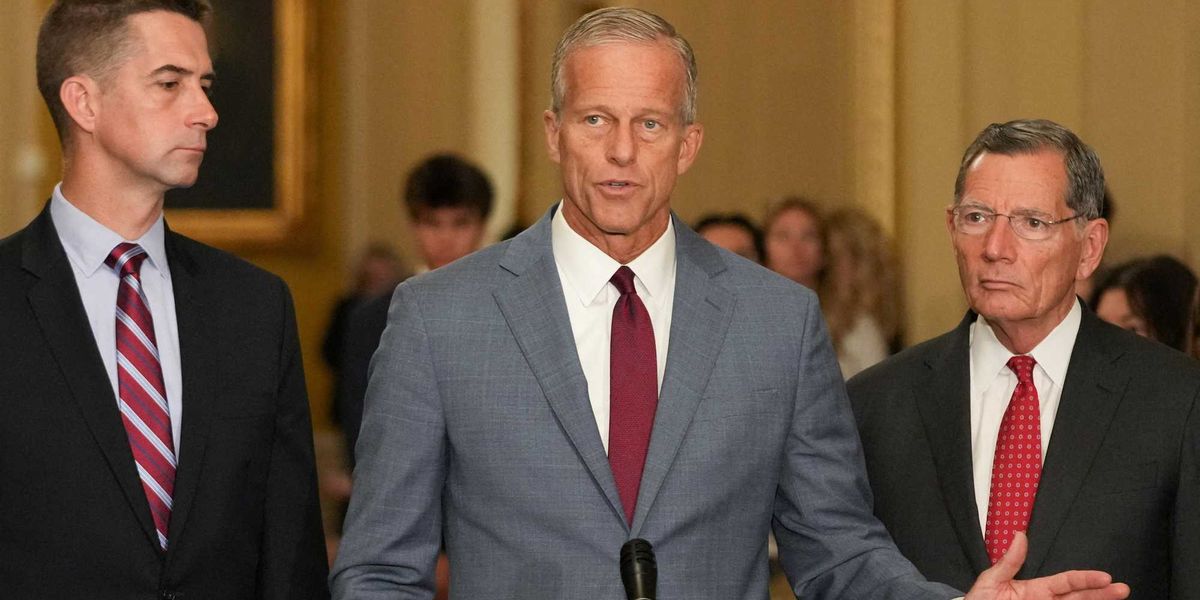
Journalist Alexander Bolton, reporting for The Hill, explains, "President Trump is headed for a clash with Senate Republicans over his decision to pause tariffs on beef imports while ratcheting up tariffs on key Canadian goods. Trump's plan to exempt 300,000 tons of product for ground beef from out-of-quota tariffs to address Americans' concerns about high food prices while simultaneously threatening Canada with 50 percent tariffs on imports that could impact auto and housing prices has sparked a furious response from GOP senators across the party's political spectrum."
One of the Republican senators who is speaking is Sen. Thom Tillis (R-North Carolina).
Tillis said of Trump's trade and economic policies, "I think it's a mistake. It's what happens when he has advisers trying to micromanage things. They're skating where the puck is versus where it needs to be. If you think that providing subsidized beef for some period of time is going to make farmers happy and prices go down on (a) systemic basis, you're wrong. It doesn't happen. Every time the government micromanages the economy, consumers suffer."
On X, formerly Twitter, Sen. Jerry Moran (R-Kansas) wrote, "Importing beef below market prices will only put further downward pressure on the livestock sector, endangering what has been a bright spot in a struggling agriculture industry. I urge President Trump to halt this action, listen to ranchers and let the free markets work."
Sen. Susan Collins (R-Maine) described Trump's tariffs threat against Canada as "a mistake," telling News Center Maine, "We produce a lot in Maine — our blueberries, our potatoes, our lobster, our lumber — that is processed across the border. If it comes back with a huge tariff on it, perhaps as much as 50 percent, that increases the cost of eating, building homes and (merchandising) our best-known products."
Senate Republican Whip John Barrasso (R-Wyoming) tweeted, "Americans want US beef on the table – not foreign imports. Wyoming ranchers produce the highest quality beef in the world. Our ranchers don't ask for special treatment. They simply want a fair marketplace. It needs to be easier – not harder – for Wyoming ranchers to feed America. I will continue to fight for policies that strengthen Wyoming beef producers and invest in the American cattle herd."
On X, Sen. Tom Cotton (R-Arkansas) posted, "Beef prices are too high for a simple reason: Our cattle herd is too small. Imported beef below market prices will only put more pressure on our cattlemen. I have advised the President against this ill-advised action in the past and I now urge him to reconsider. We need to support our cattlemen, grow the herd, and let the market work."
There’s some delicious irony here. Take Senator John Barrasso from Wyoming. He’s an orthopedic surgeon by trade, so he’s no dummy (although Ben Carson helped to deflate the “smart as a brain surgeon” myth, didn’t he?!). He’s also as big a toady as can be found in the Senate, quietly worming his way up the ladder by standing behind Mitch McConnell’s shoulder for years and complicitly supporting every Trump action, lie and miscue. But - finally - Trump went too far because he’s harming Wyoming ranchers (the myth of the Wyoming Cowboy and Wyoming as an ag state is somewhat misleading; direct ag accounts for about 1-1.5% of Wyoming GDP and about 2-4% of Wyoming employment). So sad, John.
Finally, let’s talk about the elephant in the room when it comes to beef: meatpacker industry concentration.
When it comes to beef, there are really two different prices to consider: the price ranchers receive for cattle and the price consumers pay for beef. The U.S. beef-packing industry is highly concentrated. As with any market concentration, this gives meatpackers considerable bargaining power when buying cattle. the less options ranchers have to sell their cattle to, the more likely buyers (meatpackers) are to have pricing power (i.e., the ability to pay less for cattle than if they had to compete with a larger number of buyers). The end result is ranchers get squeezed.
Meatpacker concertation is something the GAO has looked at for decades. Its research found that areas with less competition among packers had lower cattle prices, suggesting that concentration can matter to what ranchers receive.
From a political perspective, Trump has seemingly opened the door wide for rural state Democrats to march right on through. Will ranchers defect en masse and vote for Dems? Not likely. But Trump’s brazen move can be used to inform voters that he only cares about himself - not his constituents - and Republican electeds in their rural states have been complicit in harming them and their families.
‘
It’s worth a shot.
Eric Burdon & The Animals - It’s All Meat
